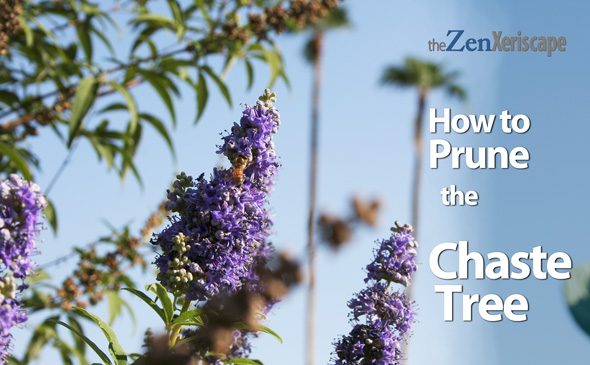
The vitex tree (Vitex agnus-castus), which might also be sold as the monk’s pepper or chaste tree, is an abundant bloomer as well as a prolific producer of seeds. Fortunately, those seeds make it easy to propagate this beautiful, hardy, and drought-tolerant tree. Read more about the vitex tree seeds and propagation techniques.
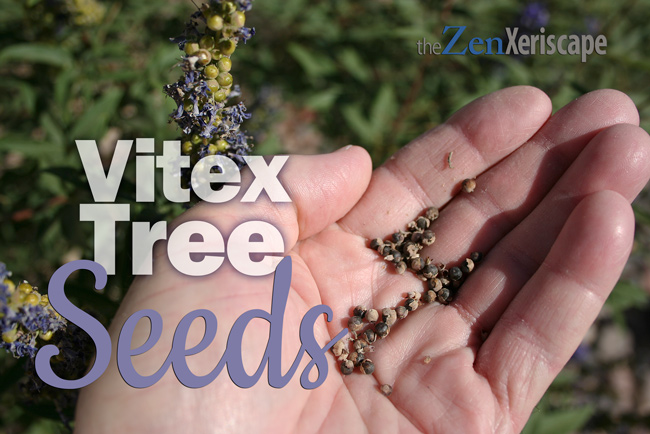
produces a seed. The seeds can drop to the
ground and sprout into seedlings, or you can
grow them in small starter containers.
Photo by Doug Martin
Vitex tree seeds and propagation
Description of vitex tree seeds
Vigorous blooms in the spring
The vitex tree has its most profuse blooming period in the spring, at least here in the southwestern United States (USDA hardiness zone 9b or 10a). Fortunately for the homeowner with an arid landscape, this tree can also bloom throughout the summer and fall, too. However, during the summer months, the blooms from this tree will be less abundant.
Small blue flowers clustered together
The small flowers are a vivid lavender-blue, and hundreds of the flowers are clustered together on panicles, which emerge at the ends of the woody branches. The flowers are long-lasting, and attract many pollinators, including bees, hummingbirds, and butterflies.
Each pollinated flower will make a seed
After the flower wilts, it will produce one seed per flower. That means on an entire panicle, or large cluster of flowers, you might see hundreds of fertilized seeds.
Seeds will be green at first
The seeds are peppercorn-sized, and can actually be a similar color to a peppercorn. However, as the seeds begin to grow, they will initially be green.
Dry seeds turn dark brown
But, over time, the vitex tree seeds will slowly dry out and turn a dark, earth-colored brown. Once the seeds have completely dried out, they are easy to harvest from the panicles. Or, the dry seeds could also easily fall to the ground, where they might sprout into seedlings.
Birds love to eat the seeds
I’ve noticed that birds love to congregate around and on my vitex trees. There, they will happily eat the dry seeds.
—Finches, doves, and starlings
The colorful finches in my neighborhood seem to love these seeds, as well as the less-desirable starlings. In addition, doves graze and peck underneath the tree, and I’m assuming they are eating the seeds that have dropped to the ground.
And as the birds eat, they can easily shake loose other dried out seeds, which might fall to the ground. Or, if there’s a breeze, the seeds might blow a few feet away. Fortunately, I’ve found that some of those seeds will sprout into new vitex seedlings. I’ve even found seedlings that are few feet away from the tree’s canopy!
Unfortunately, one of the cons of the vitex tree is that, because the seeds can sprout so easily, and because there are so many seeds, this plant can become invasive. However, I just spend a few moments, usually in the springtime, to pull them, just like I would other weeds.
Fortunately, I’ve also had great success by transplanting those small seedlings into other areas of my landscape. And, because the tree is so hardy and so vigorous, those seedlings have even flowered during their first year after transplanting!

lavender-blue flowers on the vitex tree.
Each pollinated flower will produce a seed!
Photo by Doug Martin
Vitex tree seeds and propagation techniques
How to propagate the vitex tree
—Transplant seedlings
Dry seeds fall to ground
Fortunately for landscapers like us, the dry seeds can easily fall to the ground and sprout into new plants. In my case, I have only propagated the vitex tree by transplanting the seedlings.
Seeds sprout and grow on ground
Transplanting this tree’s seedlings is so easy, and every single one of my transplants have survived and grown into beautiful, flowering vitex trees. If I can do it, you can do it, too!
Plant seedlings in new location
First, loosen the soil around the seedling, then carefully lift it. While you do, be sure that the seedling’s roots remain intact.
Protect seedling roots
The seedlings I’ve removed and transplanted usually had a taproot that extended 3-to-4 inches beneath the surface. Be sure that the taproot is undamaged.
Transplant in well-draining soil
Then, transplant the seedling to another location in your landscape. If necessary, amend the soil with organic potting soil, and a little perlite. In addition, be certain that the new seedling is in a location where water drains quickly away from the trunk.
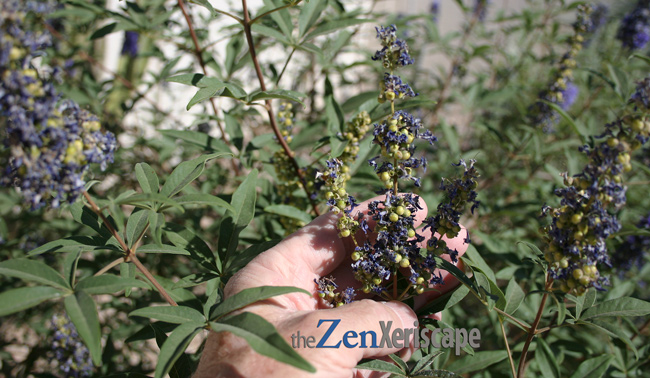
a green seed, about the size of a peppercorn.
After the seed dries, it will turn dark brown.
Photo by Doug Martin
—Plant vitex tree seeds in containers
Plant seeds in indoor containers
Depending on your USDA hardiness zone, it might be faster to take the seeds and plant them indoors in seed-starting containers. Unfortunately, I have never tried this technique, because the seedlings in my own landscape are so abundant.
Do dry seeds or green seeds germinate the best?
But, based on my limited experience, I would use the dry seeds to plant in these containers. However, there are differing opinions that I’ve read online—some growers claim that the green vitex tree seeds germinate with more consistency.
Even so, I would think that all of the seedlings in my landscape must have come from dry seeds that had fallen to the ground. Therefore, I would think that the dry seeds would sprout the best!
Unfortunately, I don’t have a definitive answer (with scientific proof) to the question of whether green seeds or dry seeds would germinate the best. But, if I were planting vitex tree seeds in seed-starting containers, I would use the dry seeds. Or, you might do you own scientific experiment—plant dry seeds in half of the containers, and plant green seeds in the other half!
Birds eat the dry seeds and defecate
Also, when birds eat the dry vitex tree seeds, they might fly to another location a few hours later, and leave some droppings. Among those fertile droppings, there might be a vitex tree seed ready to sprout.
When it does sprout, the seedling will be surrounding with nutrients. Those nutrients will help it get off to a quick and healthy start with its new life as a seedling.
That’s another unscientific reason that I believe dry seeds are the best choice when starting new vitex tree seedlings! If you have a different opinion based on your own experiences, please share them in the comments section below!
TAKEAWAYS:
Vitex tree seeds and propagation
Abundant display of flowers
The vitex tree has abundant displays of small, lavender-blue flowers. Each pollinated flower produces a seed. So, from one cluster of flowers, it’s easy to harvest hundreds of seeds.
Seedlings from seeds
The seeds will easily germinate once they dry-out and fall to the ground. Those seedlings can easily be transplanted to a new location in your landscape, where they can quickly grow and make more flowers and seeds!
Do green or dry vitex tree seeds germinate the best?
But, do the dry seeds germinate most successfully, or do the green seeds germinate with the greatest succcess? Based on my own unscientific experiences, I believe that the dry seeds germinate the best.
However, there are growers (at least ones I’ve seen online) who believe that green vitex tree seeds germinate the most successfully. What is your experience? Please share your thoughts in the comments section below!
Thanks for reading our vitex tree seeds and propagation post. If you have your own experiences with the vitex tree and its seeds, please share your thoughts. Or, if you’d like to read about pruning your vitex or chaste tree, check out this article!
Content and photos by Doug Martin and The Zen Xeriscape