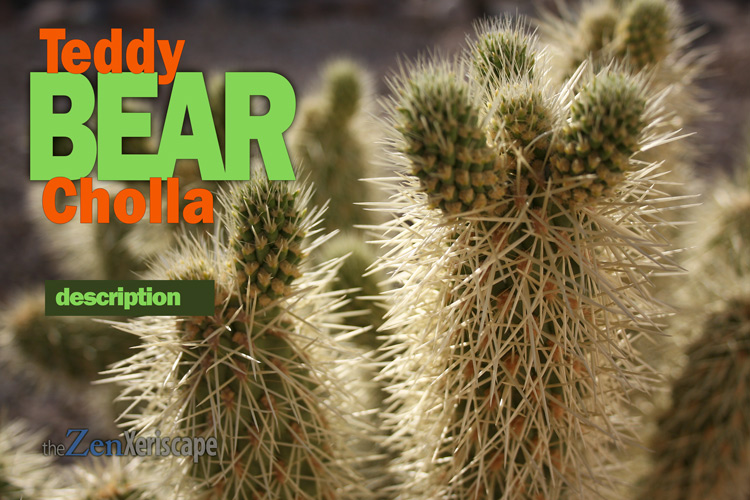
From a distance, the teddy bear cholla cactus looks fluffy and huggable—just like a teddy bear. But, once you get closer, the inviting sharp spines that glisten in the sun and emit a warm glow slowly turn into menacing sharp claws. So, here is the teddy bear cholla description.
ambience to any xeriscape.
Photo by Doug Martin
Teddy bear cholla description
Jumping cholla is the teddy bear cholla
The teddy bear cholla cactus (Opuntia bigelovii or Cylindropuntia bigelovii) is also known as the jumping cholla. It is native to the Sonoran Desert in the southwestern United States and northwestern Mexico, as well as the Mojave Desert in California.
In the desert, the teddy bear cholla has spines that appear to glisten with a golden hue during the southwestern dawns and dusks. Fortunately, that beautiful golden hue will appear in your own landscape if you include this unique cactus variety.
Grows with segments
This cholla cactus has branches, which I call segments. Usually, the cylindrical segments grow to be about 6-to-10 inches long before a new segment emerges near the tip to continue the process.
As the segments age, they can get thicker, as well as longer. The thicker segments at the base of this cactus can, over time, turn brown and take on the appearance similar to a tree trunk!
From a distance, this cactus can eventually look like a small tree. It will have its harder, brown trunk at the base, but the segements will be greener and fleshier near the top.
Segments are covered with spines
Each segment of this cactus is densely covered with white or lighter yellow spines. The spines are an inch-or-two in length, and can take on the translucent colors of the sun and the sky.
Ironically, this is a very pretty cactus, at least from a distance. And its beauty is what makes the teddy bear cholla a wonderful addition to an arid landscape.
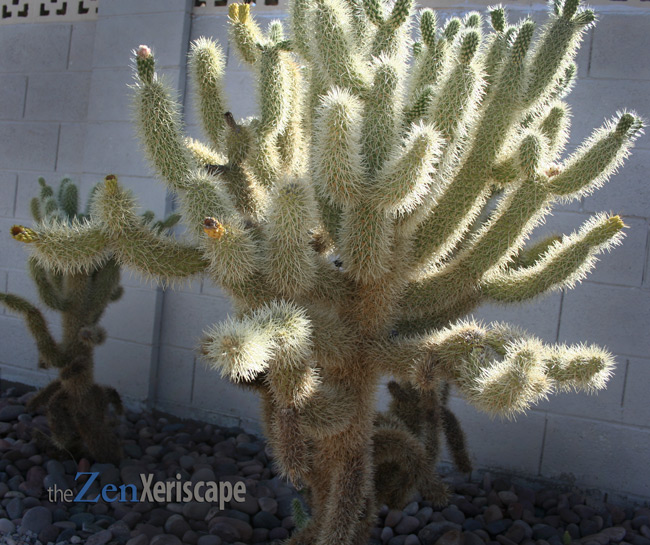
gets thicker and turns brown with a tough
texture as it ages. It looks like a tree trunk!
Photo by Doug Martin
Height, width, and growth rate
At maturity, your teddy bear cholla could reach a beautiful 4 to 8 feet in height, and it will have a 2-to-5 foot width. As your cholla ages, its trunk could get 6 inches thick with a tough, bark-like texture.
—Unique-looking trunk
In fact, the old growth at the base of the cactus reminds me of an old, grizzled tree trunk. The newer growth, however, will retain a fleshy green hue and texture, and will be covered with long white spines that glisten in the sun.
Long spines with microscopic barbs
The teddy bear cholla, commonly known as the jumping cholla, can literally appear to jump out at an innocent hiker and latch its spines into skin or fabric. All it takes is a light touch to get a teddy bear cholla spine to affix itself to your skin.
This cactus has long, thin spines, and its tips are armed with microscopic barbs. Once the tips of the spine penetrate your flesh, they will split open just like a barb.
Spines help the cholla propagate
It’s a diabolically clever design—once the spine’s barb on its tip locks into your flesh, a whole cactus segment can detach and follow you along. Then, after you carefully pry each spine out of your skin, the segment drops into the sand at its new location. There, it will root, and a new teddy bear cholla will grow.
So, the teddy bear uses its spines not only as a defense system, but also as a way to propagate miniature versions of itself all over the neighboring desert floor.
Spines also protect its flesh from sunburn
When you look at a teddy bear cholla from far away, it looks like it is covered with a coat of glowing fur. However, the bearish-type of fur is only an illusion. Instead, the spines are densely packed and help shade the green flesh from the harsh rays of the desert sun.
Tiny, almost invisible glochids
Teddy bear cholla spines have stuck me plenty of times. Sure, they hurt a little, and the barbs will pull at your flesh as you remove them. But, the most painful and annoying type of spines on this cactus are the almost microscopic, translucent glochids.
—Small, almost invisible spines
Since glochids are so small, they are hard to see. Once they are in your skin, you can feel the pain, but you can’t always see the source.
Years ago, I transplanted a teddy bear cholla segment. I grabbed a tiny space on the segment where I thought were no spines. Ouch! Even though I couldn’t see them, I had put my finger directly into a forest of glochids.
—Painful removal process
That set off a chain reaction—first, I instinctively pulled my finger back, and promptly impaled a barbed spine into another finger. After I composed myself, I used a nearby rock to pry the spines out of my flesh. The segment fell on the ground.
To remove the glochids, I carefully brushed my clean hand across the finger. That easily dislodged the glochids, and they floated away.
Floating glochids can be dangerous
A floating glochid can be especially dangerous—as the glochids are floating in the air, they can easily land in your eyes, nose, or clothes. If that happens, those almost invisible glochids can cause a serious medical issue.
That is why I don’t worry so much about the teddy bear cholla spines, but worry most about its tiny glochids.
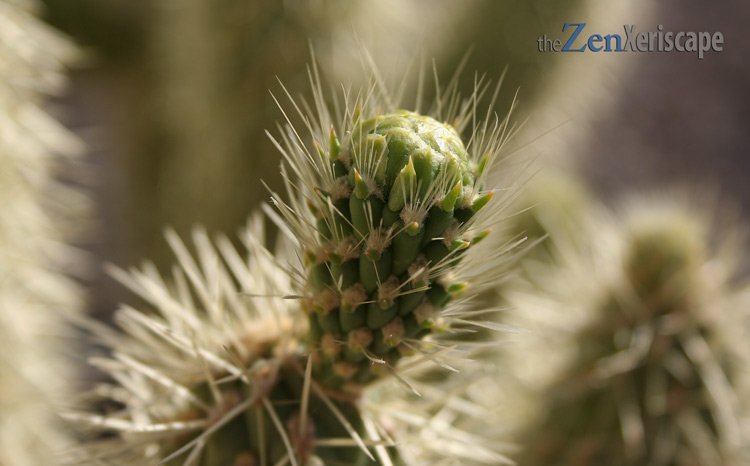
it is a new flower bud.
Photo by Doug Martin
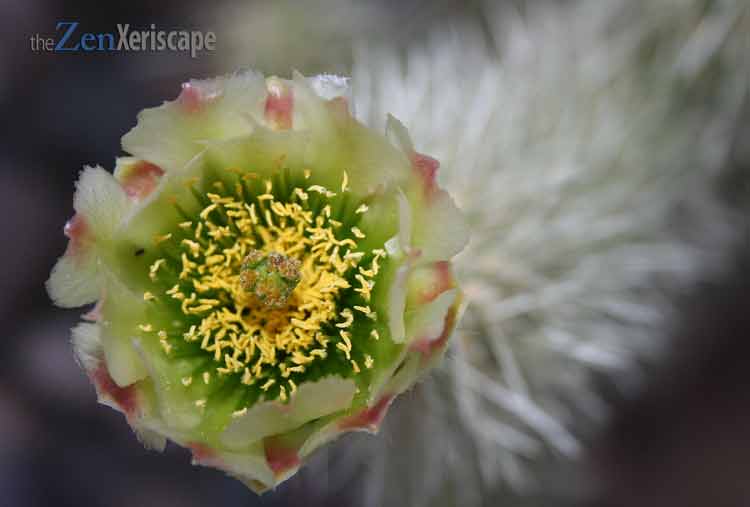
but their green and yellow hues
sometimes make them blend in with the cactus.
Photo by Doug Martin
Flowers look pretty, but are unspectacular
Teddy bear cholla cactus plants have pretty flowers, but they don’t last long. They don’t have the spectacular reds, pinks, blues, yellows, and whites that many other cactus varieties have. Instead, the teddy bear cholla’s flowers are a pastel and pale yellow or green, with a little tinge of orange.
Teddy bear cholla segments are easy to propagate
The flowers rarely end up with fertilized seeds. From an evolutionary standpoint, it seems the teddy bear cholla does not depend on seeds for most of its propagation. Instead, its segments can easily drop off and quickly root in the soil.
If an animal gets a segment stuck to its body, it might eventually drop off a great distance from the original plant. There, the abandoned segment will root, grow, and start the whole process of dropping segments and propagating its species.
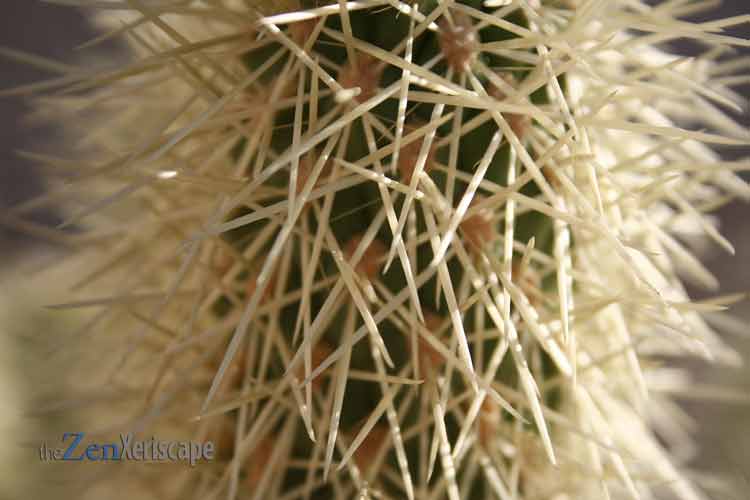
They help shade the cactus flesh, and
they protect the plant from hungry predators.
Photo by Doug Martin
TAKEAWAYS:
Teddy bear cholla description
The teddy bear cholla is a moderate-sized cactus. This cactus grows in segments, and each segment holds densely packed, white or light yellow spines.
This cactus gets flowers. They are an inch-or-two in diameter. The flowers on my teddy bear cholla be green or yellow when they first bloom. Unfortunately, because of the pastel green or yellow hues, the flowers can sometimes be difficult to spot from a distance.
This cactus is easy to propagate. Segments are loosely attached, and can easily drop to the ground. Or, unsuspecting animals might carry them away to a new location. In their new location, the segments will easily root and start a new plant.
Teddy bear chollas are drought tolerant, and thrive in the sunny, hot and dry climate common in the southwestern United States. When planting in your landscape, plant only in low-traffic areas to avoid injury to unsuspecting children, pets, or pedestrians!
Teddy bear cholla description and comments
Thanks for reading our teddy bear cholla description! If you have experience with this unique cactus, please share your thoughts in the comments section below!
Content and photos by Doug Martin and The Zen Xeriscape