The desert lavender (Hyptis emoryi) is an attractive accent shrub for any arid landscape. This plant has a delicate, but untamed appearance, along with small, blue-purple whimsical flowers. And, the small, blue-green leaves emit a uniquely wonderful fragrance. Here’s the desert lavender description, and how you might use it in your xeriscape.
Desert lavender description
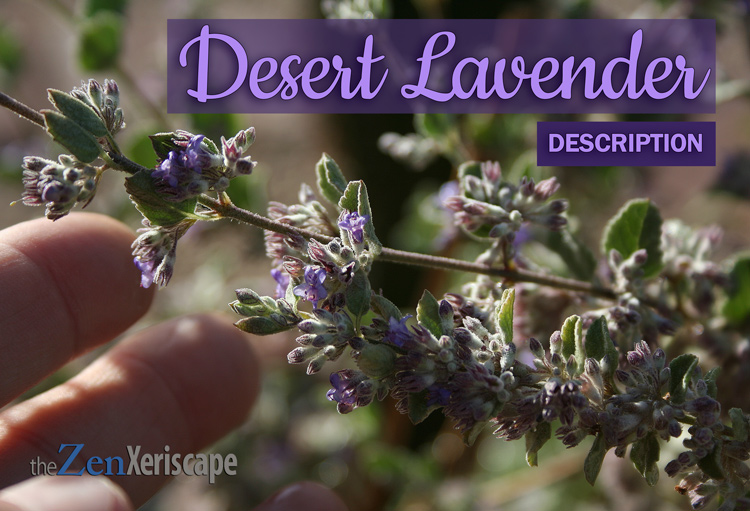
with a rangy growth habit. It’s leaves emit
a uniquely wonderful fragrance.
Photo by Doug Martin
Desert lavender has wonderful fragrance
—Desert rains enhance the scent
In addition to its delicate appearance, the desert lavender shrub has an unmistakable fragrance that envelopes the landscape, especially after a desert rain. While I would not describe it as a traditionally sweet lavender smell, the fragrance reminds me more of sage.
I like this plant’s scent much better than the other lavenders that we enjoy in our arid landscape. In fact, this might be my favorite lavender scent of all. Its earthy, full-bodied fragrance is like a fine wine that sparks camaraderie as we enjoy a relaxing evening under the stars.
—Fragrance is similar to Spanish lavender
If I had to choose a lavender fragrance that is similar to the desert lavender’s scent, I would say the Spanish lavender is close. It’s not too sweet, and not too bitter. It’s just right.
Native desert plant
The desert lavender is a native, naturally occurring plant in the southwestern United States. It grows in Arizona, southeastern California and even southern Nevada. You might even see this shrub growing in arroyos in southern New Mexico, and on the hills and washes in northwest Mexico and Baja California.
In those dry, desert locales, you’ll usually find the desert lavender growing in elevations up to 2,000 or 3,000 feet. This shrub can grow on dry, rocky hills, as well as arroyos, washes, and canyons.
Leaves are hairy
The leaves have fine, almost microscopic silvery hairs. Their appearance reminds me of the woolly butterfly bush and its hairy leaves.
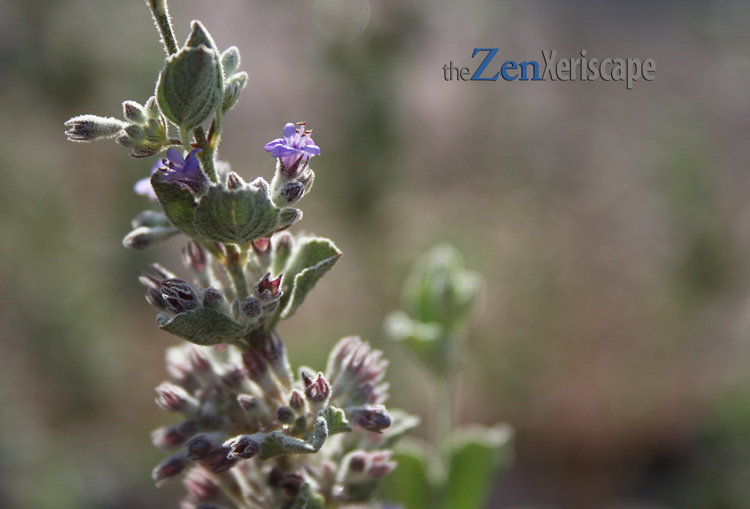
of silvery hairs. The leaves almost cuddle
the clusters of flowers that are blooming.
Photo by Doug Martin
—Silvery hairs serve a purpose
For both the woolly butterfly bush and the desert lavender, their dense, silvery hairs reflect the desert sun to protect the surface of the leaf. In addition, the hairs help impede excess moisture evaporation from the leaf so the shrub can survive long, dry desert days.
—Leaves have medicinal benefits
Just like the Spanish lavender, the desert lavender’s leaves emit the heavenly, relaxing fragrance I mentioned earlier, and they also have medicinal benefits. While I’ve never sampled the desert lavender leaves, they can be used in tea, or to sooth sunburned skin, bee stings, or cuts.
Abundant flowers
—Flowers are small
Flowers for the desert lavender have similar blues and purples common with other lavenders. The shrub’s flowers are tiny, and grow in clusters along the bush’s fleshy stems.
As you might expect, bees love the flowers. Even as I planted my desert lavenders, the bees were not deterred. They completely ignored me and my disruptions as they busily flew from flower to flower.
Growth rate
This shrub is drought-tolerant and can survive infrequent waterings in the landscape. But, if you give it extra water, the desert lavender will reward you with extra fast growth and more abundant flower blooms.
Under optimal conditions, this shrub could reach 8 to 10 feet high, and almost as wide. My plan is to keep my desert lavenders no higher than 6 feet and no wider than 4 feet. Those dimensions will allow the leaves and flowers to spill over and embrace the nearby organ pipe and opuntia cacti.
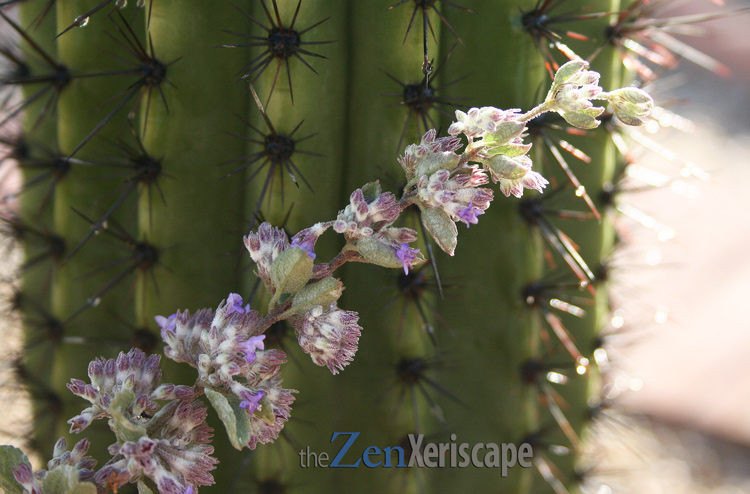
brush against a neighboring
organ pipe cactus.
Photo by Doug Martin
Growth habit
The desert lavender’s growth habit is asymmetrical. This shrub can quickly get rangy, and will be difficult to trim into a neat hedge. I let mine growth naturally and prune lightly.
—Look for color and size contrasts
To accommodate this shrub’s rangy growth, you might pair it with smaller autumn sages. I think the red, white, or purple autumn sages would be a lovely contrast with the blue hues of the desert lavender. Their sizes would also contrast nicely.
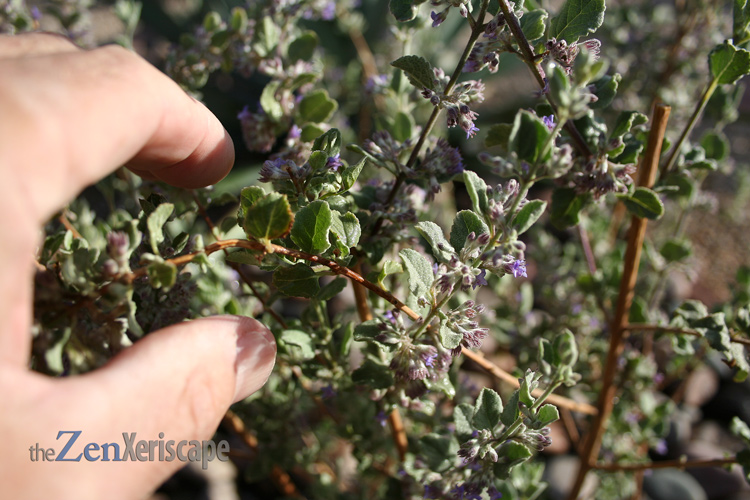
growth habit, and can get quite rangy over time.
Photo by Doug Martin
Hardiness zones
The foliage and flowers of the desert lavender might get zapped by a 32-degree Fahrenheit frost, but the roots and base of the plant should survive temperatures down into the 20’s.
In its natural growing environment, those low winter temperatures might happen every year. Normally, the warmer days that follow will spur new growth from the base.
The USDA hardiness zones for this shrub include 8 through 10. Maybe, a 7a or 7b hardiness zone would even work, but winter night-time protection would be necessary to keep this shrub as a perennial.
Drought-tolerant, but also tolerates water
—Tolerates and enjoys extra water
Desert lavenders love the sun, and they love well-draining soil. Since they naturally grow in desert washes, this shrub can tolerate extra water or extended periods of drought. In fact, extra water will spur more flower blooms and more vegetative growth.
—Desert lavender is drought-tolerant
Despite their tolerance of excess water, the desert lavender is still a drought-tolerant plant. It will survive during long periods of drought.
Because this shrub grows naturally in higher altitudes, it might suffer during the extreme summer heat that is common in the low altitude, southwestern summers. So, provide some afternoon shade during the summer if you live in areas like Phoenix, Arizona.
Desert lavender landscape uses
While the desert lavender would not work as a focal point in your landscape or xeriscape, it would be a beautiful background or accent plant. That’s how I’m using my desert lavenders.
From a distance, the shrub’s diminutive leaves and flowers make it appear like a desert mirage with silver-and-blue waves of color. To me, the mirage appears beautiful and inviting, especially when the shrub is paired with a large cactus or agave.
My desert lavenders are close to my outdoor seating. That’s nice, because as the sun goes down and the evening cools, the scent of the desert lavender creates a relaxing atmosphere that is perfect for entertaining or moments of solitude.
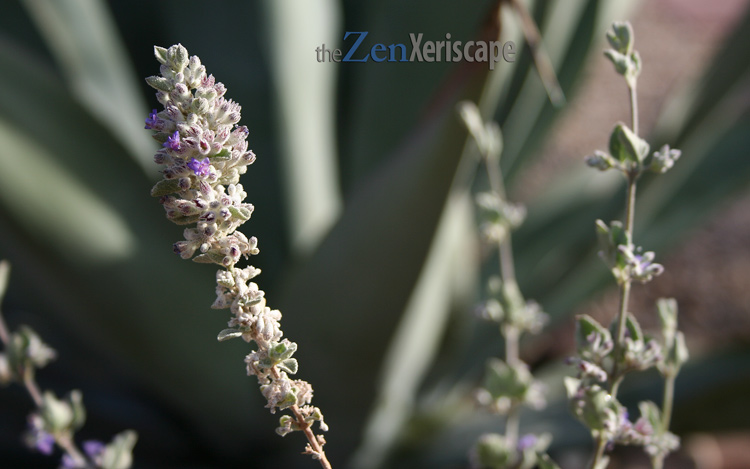
to a large blue agave. The two plants
contrast nicely with each other.
Photo by Doug Martin
TAKEAWAYS:
Desert lavender description
Enticing fragrance of desert lavender
I love my desert lavender (Hyptis emoryi)and how its small leaves and equally small but abundant flowers contrast so beautifully with other desert plants. Best of all, I love its unique, musky scent. Not surprisingly, the desert lavender’s fragrance has a subtle sweetness along with a subtle pungency that is perfect for any outdoor living area.
Perfect shrub for an arid landscape
My wish is that more people would use this lovely shrub as an accent plant in their xeriscape or drought-tolerant landscape. If they did, they would grow to love the desert lavender just as much as I do.
Thank you for reading our desert lavender description. And, if you have this wonderful plant in your xeriscape or rock garden, please share your experiences and thoughts!
Content and photos by Doug Martin and The Zen Xeriscape