The brittlebush shrub (Encelia farinosa) grows naturally in the Sonoran and Mojave Deserts of the southwestern United States. It is an adaptable, hardy plant, and survives intense heat, along with drought and even monsoon conditions. Here is the brittlebush description and care guidelines to use when you include this shrub in your xeriscape.

summer sun. Even better, it looks great
in an arid landscape.
Photo by Doug Martin
Brittlebush description and care
Brittlebush description
Daisy family
—Yellow, daisy-like flowers
The brittlebush (Encelia farinosa) is a member of the daisy family. Just like other daisies, the brittlebush produces beautiful yellow, daisy-like flowers. While smaller than a typical sunflowers, the flowers still add a vibrant splash of golden-yellow warmth to any drought-tolerant xeriscape.
Rounded growth habit
Mature brittlebushes have a rounded growth habit. When I first planted my young bush, it only had a few stems extending from the base. Now, more leafy stems have sprouted and have grown quickly.
As the shrub grows, blue-green leaves emerge and are supported by woody stems. From a distance, the plant looks like a round mound of vegetation punctuated by stems of flowers.
In the desert, many of the brittlebushes I’ve seen have been mounds of about two-to-three feet high. However, with a little extra water and warmth, your brittlebush might reach a height of four-to-five feet.
Woody stems are brittle
The brittlebush shrub grows quickly, but the fast growth can make the woody stems break easily. Fortunately, the brittle stems make this shrub easy to prune by hand.
—Sap might cause a skin rash
But, once broken, the stems emit a resiny, tacky sap. And for me, the sap caused a red, uncomfortable rash on my skin. Fortunately, the rash disappeared quickly after I washed with warm, soapy water.
Yellow flowers almost all year
—Most abundant flowers in late-winter through spring
Even though the brittlebush might flower all year long (depending on your hardiness zone), it produces its most abundant show of flowers in the later-winter through spring seasons. The more moderate desert temperatures allow the plant to devote more resources to flowering during those months.
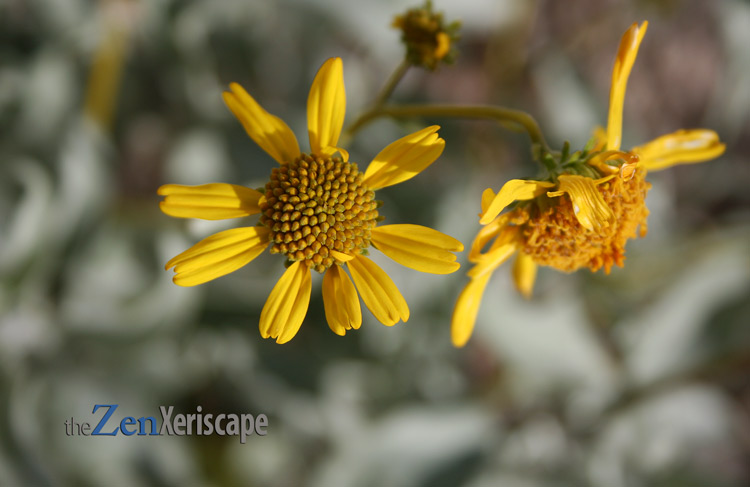
appearance and color. The shrub blooms
during the late-winter through the spring seasons,
but can also bloom more sparsely throughout the year.
Photo by Doug Martin
Flowers attract pollinators
Like many desert plants, the flowers of the brittlebush attract many natural pollinators. I’ve seen bees, butterflies, and even the occasional hummingbird hover around the bright yellow flowers of my brittlebush.
In addition, quail and other birds enjoy the shade from this dense shrub while they eat the dried-up seeds that haven fallen around the plant.
Seeds germinate easily
My young brittlebush has already produced lots of flowers. After they wither, the seed heads dry out within a few weeks.
If you let the seeds alone, they eventually dry out so much that the wind will naturally blow them throughout your landscape. When conditions are right, the seeds will germinate easily.
I’ve taken a handful of dried seeds and planted them in loose soil around the drier perimeter of my landscape. Many of them have germinated and grown.
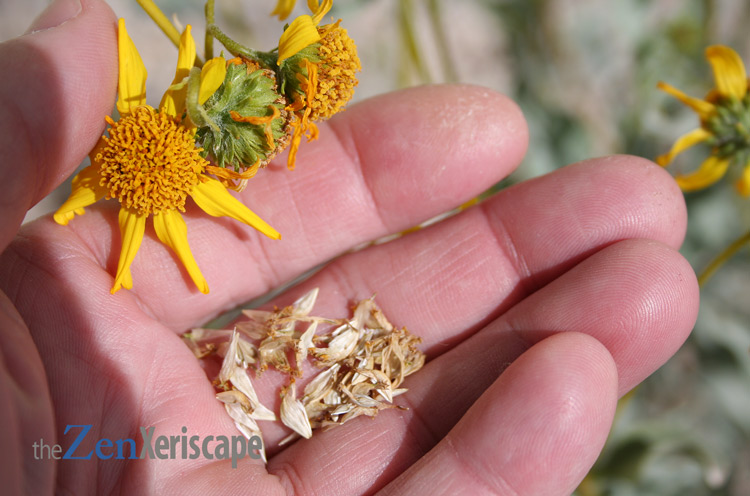
blow away in the wind, and will easily
germinate under the right conditions.
Photo by Doug Martin
Brittlebush leaves
This shrub has unique, silvery blue-green leaves that are covered with fuzzy white hairs. The hairs, which are common on many drought-tolerant plants, shield the leafy flesh from the intense summer sun and heat. In addition, they help prevent the leaves from losing excess moisture.
However, despite the protection from their fuzzy hairs, the brittlebush will go dormant during long periods of drought and intense heat. So, it is common that the leaves will dry out and drop off the plant during those periods.
Fortunately, new leaf buds will quickly appear after conditions moderate. In my case, I like to prune off many of the dried-out stems. When cooler temps return with additional irrigation, the plant will quickly regenerate.
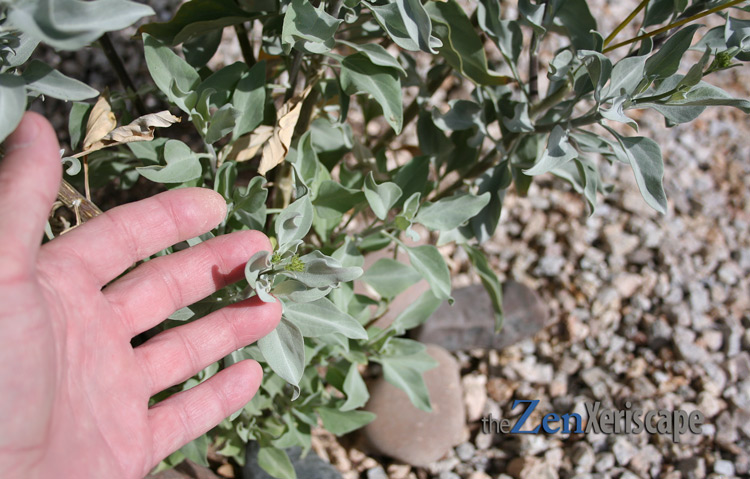
blue-green hue, and are covered
with fuzzy white hairs to dissipate heat.
Photo by Doug Martin
Brittlebush can be invasive
If you live in the southern United States, just be aware that this shrub can naturalize very easy throughout your landscape, even in places you’d rather not have them. In other words, this plant can be invasive.
Brittlebush description and care
Brittlebush care guidelines
Plant in well-draining soil
Just like most drought-tolerant plants, the brittlebush performs best in soil that drains well. In its natural desert habitat, this plant grows on sunny, rocky hillsides and close to naturally draining arroyos and washes.
However, if this plant’s roots sit in wet soil too long, they can easily develop root rot. Well-draining soil is a must for this shrub.
—Let soil dry out completely between waterings
Based on my experience, the brittlebush also tolerates overwatering. The important thing to remember when watering this shrub is to be sure the soil dries out completely before another deep watering.
Plant in full sun
The brittlebush shrub performs best in a sunny location. Although the shrub can survive in partial shade, it might become leggy and the leaves will be sparse.
In full sun, this plant will produce a blanket of yellow flowers. From a distance, the colors will brighten any arid landscape.
Sensitive to below freezing temps
This hardy shrub can survive temperatures into the mid-to-low 20 degrees F. However, at that low temperature range, it might suffer a little frost damage.
In my experience, the brittlebush is perennial in USDA Hardiness Zones of 8-11, and maybe even into Zone 7 with some winter protection. During the summer, my brittlebushes have survived hot summer temps of 120 degrees F, and possibly a few degrees more.
—Can go dormant during summer heat and drought
However, during the summer, when the temperatures get extremely hot, this shrub does look a little stressed, and the flowers, if any, are more sparse.
Prune periodically
Over time, the brittlebush can get a little rough and weary looking, especially after an extremely hot summer. In my case, I usually prune those shrubs down to about a foot in height after the summer heat has ended.
They will quickly grow back new leaves and stems, and in a few months, they will reward you with another beautiful flush of golden yellow flowers.
—No pruning equipment needed
Because the stems are so brittle, it is quick-and-easy to use your hands (with gloves) to break off a stem a foot-or-so from the ground—no pruning shears required.
—Sticky sap can aggravate your skin
However, be care not to get the sap on your skin. In my case, the resinous sap make my skin red and itchy. Fortunately, it cleared up over a few hours after I washed with soap and water.
Brittlebush description and care
Naturalize with brittlebush
Easy to grow shrub
Brittlebush is remarkably easy to grow. In fact, this plant would be a perfect starter plant for any gardener who wants to naturalize parts of their arid landscape.
Once I planted my immature plant in my unamended soil, it quickly took root and grew. Only six months later, it was producing an abundant bouquet of flowers and growing new leafy stems from its base.
In my own landscape, I planted my brittlebush in a naturalized area that receives lots of sun and is surrounded by other drought-tolerant cacti and agaves.
Brittlebush is a perfect accent plant
While the brittlebush will not be a focal point in your landscape, it is a beautiful accent plant. Use it to create contrast with your more commanding columnar cacti, or intriguing agave specimens.
In my landscape, I planted my brittlebush next to a moderate-sized agave. I’ve also planted brittlebush seeds next a Peruvian apple cactus, and a San Pedro cactus.
As the seeds germinate and grow, the bushes will add a lovely contrast of blue-gray around the base of the larger plants. When they mature, the brittlebush’s flowers will add a brilliant splash of sunny, yellow warmth.
You could also pair your brittlebush with a taller red bird of paradise bush, or as a companion to your Spanish lavender. The bright yellow flowers will be a brilliant complement to the purple or red flowers.
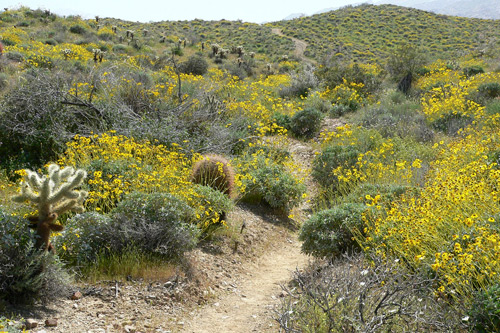
Wikimedia Commons image by Stan Shebs, CC BY-SA 3.0,
https://commons.wikimedia.org/w/index.php?curid=200733.
TAKEAWAYS:
Brittlebush description and care
Brittlebush is one of the most low-maintenance plants to include in your landscape. It is drought-tolerant, and can survive a wide range of temperatures. In addition, it doesn’t require soil additives, although the soil should be well-draining.
Best of all, your brittlebush will give you lots of bright yellow flowers, and will attract a bevy of interesting pollinators to your landscape.
Thanks for reading our brittlebush description and care guidelines. If you have included brittlebush in your xeriscape, please share your experiences in the comments section below!
Content and photos by Doug Martin and The Zen Xeriscape, unless noted