The spineless prickly pear cactus is one of my favorite opuntia cactus varieties. It grows fast, can get fairly tall, develops a hard trunk at its base, and the pads are edible. Here’s our Spineless prickly pear description, along with some helpful care guidelines.
Other names for the spineless prickly pear cactus
The spineless prickly pear (Opuntia ‘ellisiana’), has many other popular names. They include the thornless prickly pear, the South Texas prickly pear, and the tiger tongue.
No matter the name, the spineless prickly pear was cultivated from the Opuntia ‘cacanapa’, which grows naturally in Texas and parts of Mexico. You might also see it listed as the Opuntia cacanapa ‘Ellisiana’.
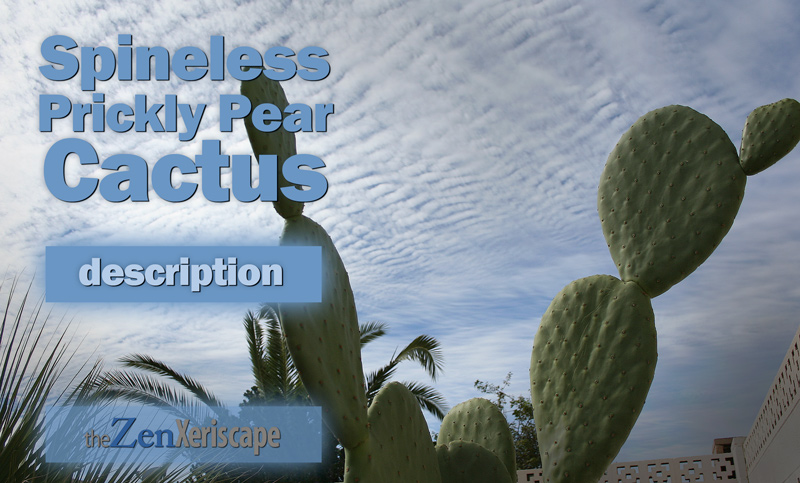
large plant the creates a southwestern-
style ambience in your landscape.
Photo by Doug Martin
Spineless prickly pear description
Spineless prickly pear doesn’t have spines
One of the most attractive attributes of this cactus is that is has no spines! I guess that’s why it’s known as the spineless prickly pear cactus.
—But, it does have hair-like spines called glochids
Despite having no large spines, this cactus, just like all opuntia varieties, does have smaller, hair-like spines known as glochids. Because they are so small and hard to see, glochids can be difficult to remove from your skin.
—Glochids can be nasty
When handling any opuntia cactus, even the spineless prickly pear variety, avoid the glochids at any cost. They can be nasty to remove from your skin, partly because they’re so small and hard to see.
—Glochids grow around the areoles
Glochids grow around the areoles of a cactus The areoles are an important feature, because new stems emerge from that area, along with the flowers and new branches.
In addition, roots can emerge from areoles. For instance, if a branch happens to get knocked off the main plant, it can root in that location and produce a new plant.
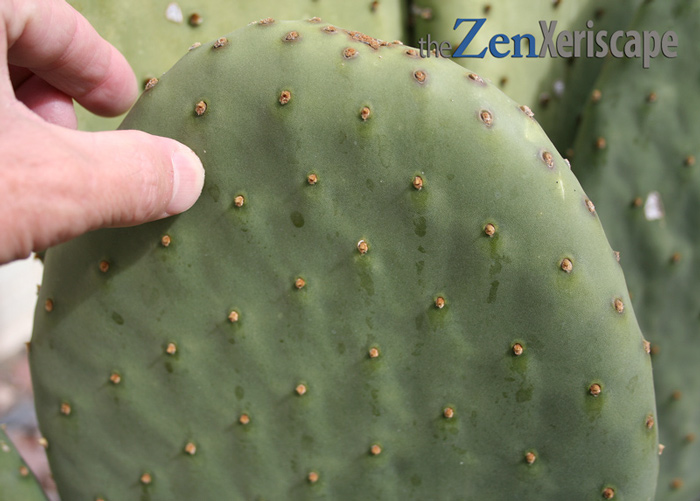
When handling, carefully place fingers on the pads
between the brown-colored areoles.
Photo by Doug Martin
Hardiness zones for perennial growth
This cactus tolerates winter temperatures into the low single digits, and mine have survived summer temps as high as 122 degrees F. Those temperatures correlate to the USDA hardiness zones of 6-to-10 for perennial growth.
The spineless prickly pear does well in landscapes situated in regions of Texas, southern Arizona, and southern New Mexico. However, you might have success planting this cactus in Florida, Georgia, and other southeastern states. The only caveat is to be sure the soil drains well—this cactus does not tolerate wet soil.
Plant in full sun
Plant the spinless prickly pear cactus in full sun, or partial afternoon shade. The best time to plant is in the fall, winter, or early spring, at least in the southwestern United States.
Your specific local climate will be the deciding factor of when to best plant. I live in southern Arizona, so summer is the worst time to start any new plant—the heat is too brutal for even native plants to establish themselves without too much stress.
Height and width
This opuntia cactus can grow up to 6 feet high (or more), and up to 3 feet wide (or more). In my experience, this cactus can grow very tall, but its weight can make it very top-heavy.
So generally, I prune it to maintain its 6-foot height, and I prune the side arms off to maintain a more narrow, tree-like growth habit. For me, that looks best with this cactus.
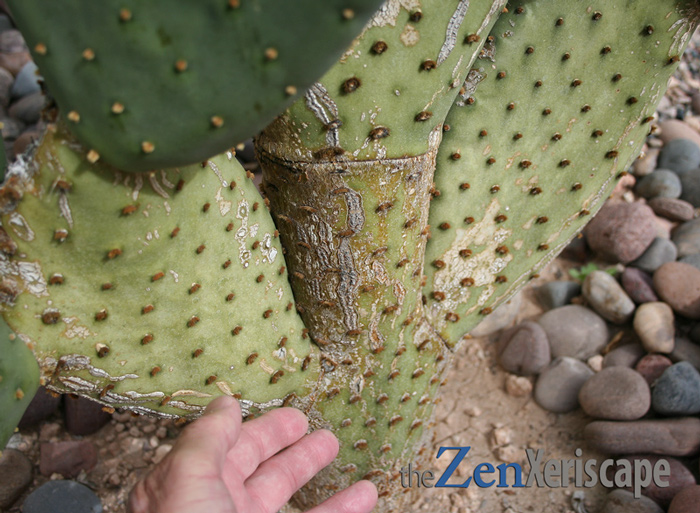
thick with a bark-like appearance like a tree.
Photo by Doug Martin
Spineless prickly pear description (continued)
Flowers and fruit
—Red, yellow, or orange flowers
Just like most cactus plants, this opuntia cactus has beautiful, abundant displays of medium-sized red, yellow, or orange flowers. In my case, my spineless prickly pears have red flowers that brighten the landscape, usually during the spring.
—Bright red fruit
The bright flowers don’t last very long, but, if they were pollinated, they will produce bright-red fruits. The fruits, also known as a pear or a tuna, are so delicious that they are almost irresistible to birds.
In fact, humans can eat the fruit of this cactus, too. Just slice open the thick outer rind, and use a spoon to scoop out the jelly-like fruit. Of course, you’ll have to spit out the hard seeds.
Pads or stems can get large and heavy
The pads or stems of this opuntia cactus can get large and heavy. The ones in my landscape have pads that are over a foot long, and two inches thick.
—May become top-heavy
Since the pads are filled with dense fluid, the weight of each large stem can be substantial. That’s why this cactus can sometimes get top-heavy without preemptive pruning or topping off.
Plant in soil that drains well
The golden rule for all succulents is that they must be planted in soil that drains well. And, that rule applies to the spineless prickly pear.
If necessary, amend your landscape soil with an organic garden soil, and add perlite, pumice, or even small landscape gravel to create air spaces for the water to seep through.
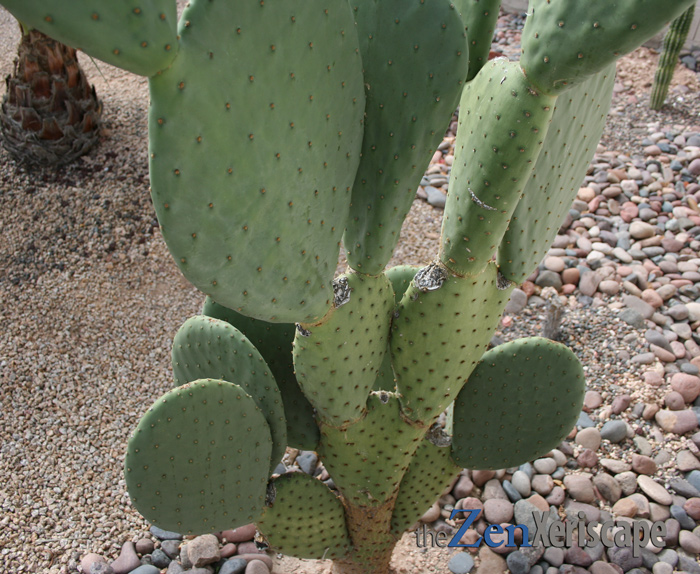
in soil that drains well.
Photo by Doug Martin
Drought tolerant
Just like most cacti, this opuntia cactus is drought-tolerant. I water my spineless prickly pear once a week to stimulate fast growth. However, it will easily survive if you water only once-a-month.
—Grows fast with extra water
This cactus grows especially fast when you provide extra water. Sometimes during the hot summer months, I will water mine twice a week. When I do, this cactus grows as fast as a weed.
—Water once-or-twice a month
However, I’ve recently cut back on watering this spineless prickly pear to once-or-twice a month. Sure, the extra fast growth was nice, but in my case, the pads became too large, and the plant became top-heavy, especially in the summer months. So, I had to cut back on my aggressive water schedule.
—Soil must drain well
If you decide to give a little extra water to your spineless prickly pear, be sure that your soil drains well. Too much water and poor drainage can kill any cactus plant.
Plant in containers
For an extra treat, you can plant this large cactus in containers. This plant does get large and heavy, so be sure to eventually replant into a large, movable plant pot or container.
Of course, be sure this container has drainage holes so it won’t sit in wet substrate.
Prune into vertical, tree-like format
My favorite way to prune my spineless prickly pear cactus is to make it look like a desert tree.
First, I remove the new stems (or pads) that emerge from the sides of the lower segments.
As the cactus grows, the lower segments will get thicker, and the outer skin will get tougher. After a few years, the lower segments will almost look like tree bark.
When I get about five or six vertical segments in the center of the plant, then I let new growth emerge from the sides of the top branch. As the years go by, the upper segments will develop so much that they will look like the crown of a deciduous tree.
Vertical format becomes a stately focal point
To me, this vertically growing prickly pear adds a stately, southwestern ambience to your landscape. After only five years, this cactus can be a beautiful focal point in any drought-tolerant xeriscape.
Spineless prickly pear pads are edible
The fleshy pads of the spineless prickly pear are edible. First, carefully peel the skin off the flesh of each pad—be sure to avoid the hair-like glochids!
Then dice into cubes, and fry, bake, or roast, and then season to desired taste. I have eaten the diced-up pads a few times, and they are pretty tasty, as well as nutritious.
However, peeling the skin and dicing the flesh is a lot of work, so I do not indulge in this culinary delight very often!
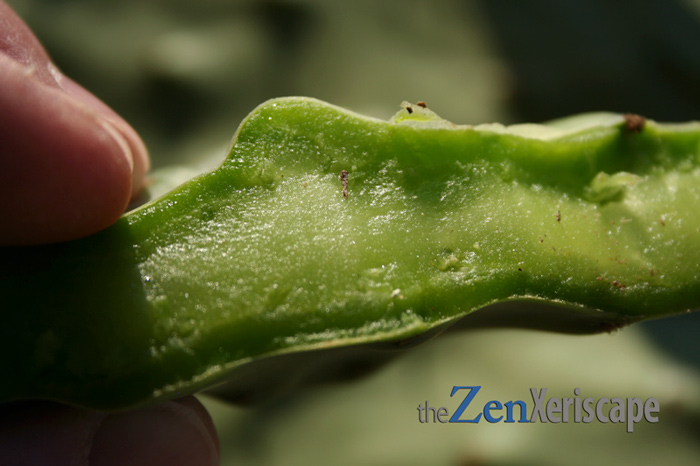
First, cut the skin (along with the glochids)
off the flesh, then dice or cube.
Photo by Doug Martin
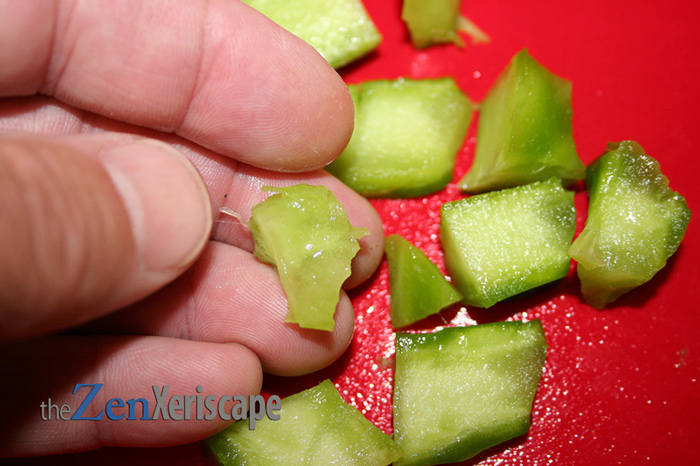
then prepare by boiling, baking, or roasting.
Season to your specific taste!
Photo by Doug Martin
TAKEAWAYS:
Spineless prickly pear description
—No sharp spines, but it does have glochids
The spineless prickly pear cactus does not have large spines like most opuntia cactus varieties do. However, it does have hair-like glochids, which can be very nasty to remove from your skin.
—Pretty flowers and fruit
In spring, and possibly throughout the growing season, this cactus has medium-sized flowers. They can be red, orange, or yellow flowers.
Eventually, the pollinated flowers will produce a pretty, red-colored fruit. The pulp contains hard seeds, but the fruit is sweet and tasty, and the birds will often fight over the fruit.
—Adds southwestern ambience to your landscape
Because of its larger size, this cactus can become a stately focal point in your arid landscape. It will add a southwestern ambience that you can savor throughout the year.
—Hardy plant, and easy to grow
Just like most opuntia cactus varieties, the spineless prickly pear is an easy cactus to grow in any xeriscape. It is hardy, and can survive a wide temperature range.
Thanks for reading our spineless prickly pear description. If you grow this hardy cactus in your landscape, please share your experiences!
Content and photos by Doug Martin and The Zen Xeriscape.