
Most columnar cacti are easy to propagate with cuttings. All you need to propagate a columnar cactus cutting are the right tools, and a hospitable place in your landscape or container. Here’s how to propagate columnar cactus.
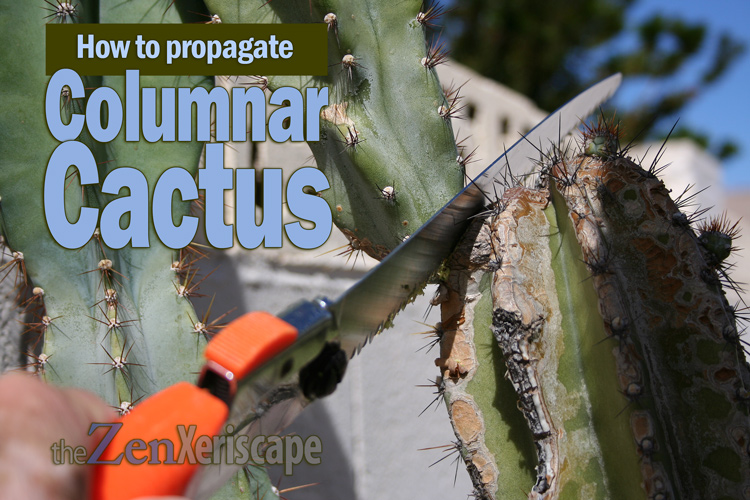
is very easy. Prune a segment or column,
and replant it. Read more about the process below.
Photo by Doug Martin
How to propagate columnar cactus
Columnar cactus varieties to propagate
In the past, I have propagated many varieties of columnar cactus, including the monstrose cactus, the Mexican fence post, the silver torch, the organ pipe cactus, and the Peruvian apple cactus (this is the variety that I am propagating in the photos).
Get help to handle large cuttings
Because of their sometimes long and heavy columns, columnar cactus can be tricky to handle when propagating. If the columns are too large and bulky to handle by yourself, then get some help.
Vegetative propagation of columnar cactus
To get started with vegetative propagation of any plant, simply cut off a stem, leaves, rhizome or roots of that plant. Depending on the plant, you will need a specific vegetative part to reproduce successfully.
For instance, with an autumn sage plant, you can divide the plant’s clump by separating the roots at the base. Or, with a bougainvillea, you can take a cutting from a woody stem to propagate.
But, for vegetative propagation of your columnar cactus, the easiest way is to prune or cut off a stem or column. In the case of a columnar cactus, you can use pruned cuttings that you might normally have thrown away.
Those cuttings will quickly root and grow into stately new columnar cactus specimens.
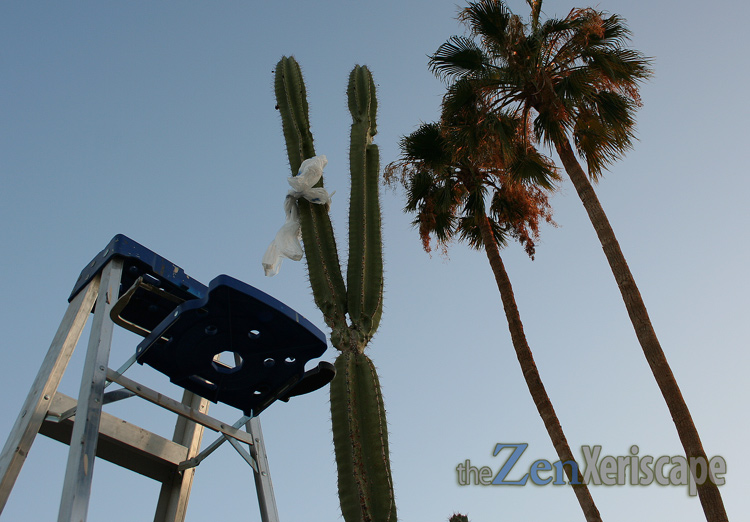
use a stable stepladder. Also, wrap rope or
plastic bags around the columns for added
stability. Above all, use caution and get help.
Photo by Doug Martin
Tools to propagate a columnar cactus
—Pruning saw, serrated knife, or a hacksaw
I used a pruning saw, but you can also use a serrated knife or a hacksaw. Any of those saws will quickly cut through a cactus stem.
—Isopropyl alcohol or bleach
To prevent bacterial infections on your new cactus cutting, always start with a knife or pruning saw blade that has been sterilized with isopropyl alcohol or bleach. After cutting, you can sterilize again. Then, your saw will be ready to go when you prune you next cactus plant.
—Cactus or succulent potting soil
If you’re putting your cutting in a container, use potting soil specially made for drought-tolerant succulents or cacti. Never use potting soils with a large percentage of ingredients that retain water. Even though I did not amend my soil when I planted my cactus cutting, the area is elevated and does drain well.
—Thornproof gloves
To safely handle your cactus cutting, use thornproof gloves. Gloves make the job go much faster, and much more safely.
—Shovel, pick, bucket
In my case, I was planting my cactus cutting directly into my landscape. So, I used a pick to loosen the soil, and then I used a shovel to dig a hole that was about 2 feet wide, and 1 foot deep.
The bucket was there to store the excavated soil. After carefully placing the cactus column in the hole, I used the dirt in the bucket to refill the hole.
—Rope or plastic bags
Other items I used to help stabilize and to help me carry the cactus column was a long rope, and a few plastic bags. I wrapped the bags around the column, and knotted them. Then, I was able to use the bags as handles to safely carry my cutting to another location.
How to propagate columnar cactus
Now that you have all your tools assembled, you’re ready to propagate your columnar cactus!
Cut the cactus stem
First, cut the stem using your sterilized knife of hacksaw. In my case, I cut off a complete 3-foot stem at its narrowest point. Then, I cut off the narrow bottom tip so more of the flesh would be exposed to the soil.
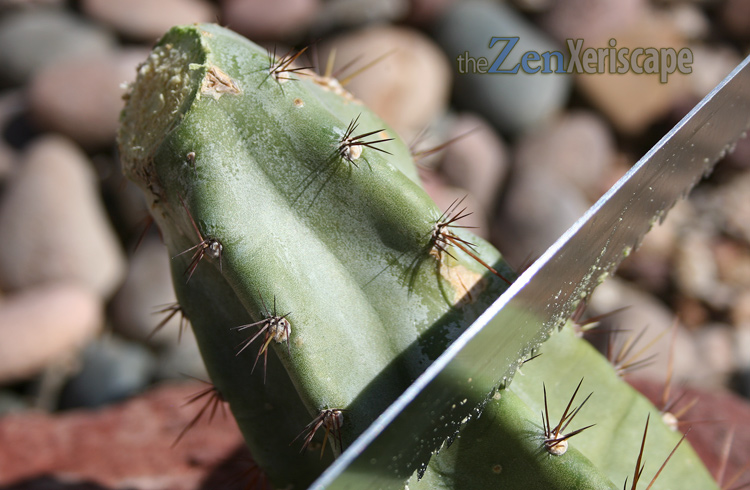
cut the narrow stem off the bottom. This will
give more area for root growth and will
also add stability to the cactus column.
Photo by Doug Martin
—Make cuts on an angle
To prevent water from accumulating on the parent plant’s wound, I made my cuts on an angle. Within two days, the wounds had calloused over. The tough skin formed by the callous protected the flesh of the parent cactus from bacteria.
Immediately after taking your cutting, you might also apply sulfur dust on the parent plant’s fresh wound for extra protection.
—Use plastic bags as carrying handles
Before I cut my cactus stems, I wrapped plastic grocery bags around each column. After I cut the stem, those plastic bags helped me keep my cutting from crashing to the ground and breaking.
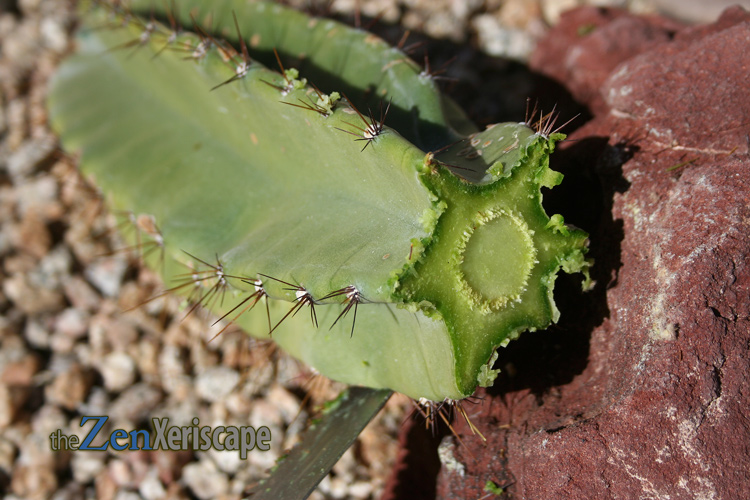
to form a callous. Or, if your soil is dry, plant
immediately. I have had excellent success
by planting my cactus cuttings immediately.
Photo by Doug Martin
Let the cactus cutting air dry to form callous
—Let cutting dry to form a callous
Before planting your new cactus cutting, place it in a dry location, preferably in the shade. There, it will form a protective callous over the wound. In my experience, a callous should form quickly—maybe within two-to-three days or a week.
The callous will help prevent your cutting from rotting before it has formed its roots. It will also protect your cutting from bacteria that might already be in the soil.
—Or, plant cactus right after cutting
However, in my experience, I’ve found the drying step to be a waste of time. I almost always plant my columnar cactus cuttings immediately. Of course, I plant them in dry soil that drains well.
—By planting right after cutting, roots form faster
By planting immediately, I’ve found that the roots form much faster, especially in warmer weather, and the cactus gets a jump on its initial acclimation process.
So, either way will work. You can spend the extra time and allow a callous to form on your cutting. Or, you can plant immediately and get a head start. Of course, by planting immediately, you do risk exposing your fresh cutting to pesky diseases, bacteria, and fungi already in the soil.
Temps should be warm for roots to form
I’ve had the fastest root growth when I planted my columnar cactus cuttings in the late summer months. By then, the oppressive desert heat is slowly subsiding, but the night-time temperatures will still remain over 60-to-70 degrees. Warm soil, especially over 80 degrees, stimulates root growth.
When you see your cutting getting plumper, or new growth emerging, you will know that your cutting has formed roots.
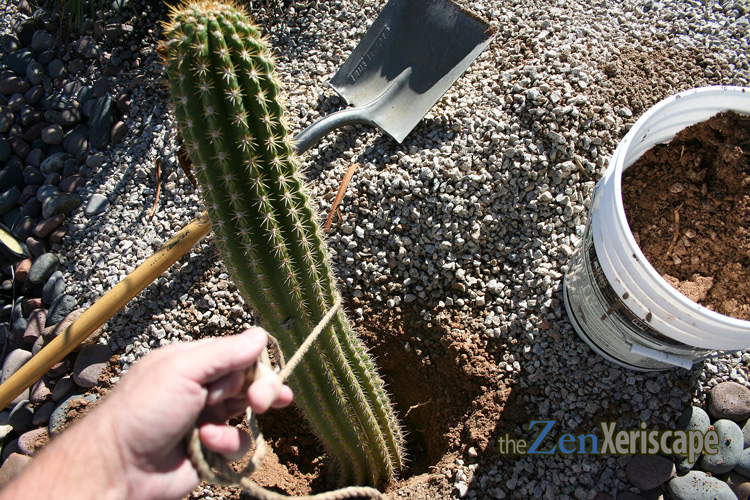
to provide stability to the long column.
Use ropes to stabilize while filling hole with dirt.
Photo by Doug Martin
Before planting, amend soil
If needed, amend your soil so it drains well but also retains nutrients. Even though the soil in my Arizona location has lots of clay, I did not amend the soil. It already has organic matter in the soil, and does drain well.
I put both of my cuttings in an elevated location that drains well. If your soil does not drain well, mix in organic soil, and a little sand or perlite to provide better aeration and drainage.
When planting in a container, use a cactus or succulent soil mixture. Look for mixtures that retain moisture so your cutting’s new roots can take up the nutrients while also providing good aeration.
Plant column deep enough for stability
Both of my cuttings were about 3 feet long. To keep them stable and upright until they formed roots, I planted the column about 10-to-12 inches deep into the soil. Then, I placed river rocks around the base to keep them extra stable. After the roots formed, I removed the river rocks.
To keep rabbits and other pesky varmints from chewing on my new cuttings, I wrapped the columnar cactus cuttings with a protective wire fence. After the cactus stem was fully acclimating with a good root system, I removed the fencing.
For extra stability in a container, be sure to select one that is deep enough for your cutting. Until the roots form, you can prop up your cutting with inexpensive garden stakes. Wrap the stakes around your cutting with inexpensive plastic lacing. After your cutting has formed roots and is stable, remove the supports.
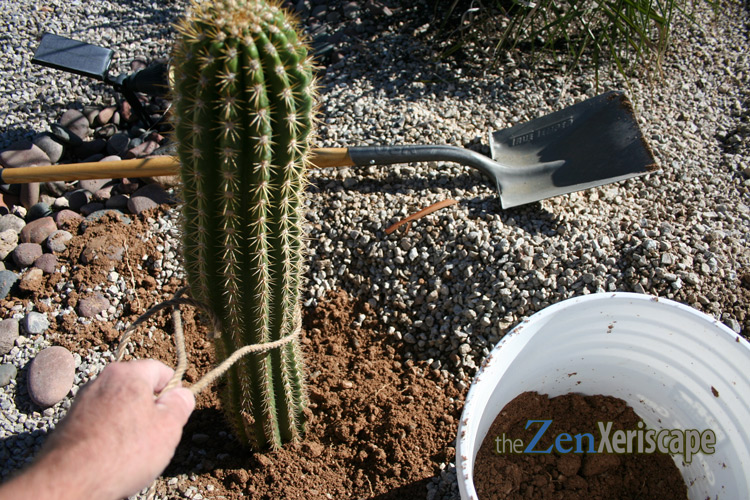
Tamp soil firmly around the column
for extra stability.
Photo by Doug Martin
Water lightly
The day after I planted my cuttings, I sprinkled each with a light shower of water. I didn’t want to soak the soil, but I wanted to add a little moisture to stimulate root growth.
I’ll give my cuttings another light shower of water each week. In between, the soil should completely dry out.
Use extreme caution when adding water. Too much water can quickly rot your brand new cutting, especially if it has not developed roots. It is always better to water too little than to water too much.
Remember, too much water can kill cactus
For your new cactus cutting, too much water can quickly rot your cutting. That’s why it was so important to use soil that drains well. Let your new cutting dry out completely before adding any water. When you do add water, do so sparingly.
Add some fertilizer, or not
In the past, I have added a small amount of well balanced fertilizer to my ocotillo and other xeriscape plants. However, I’ve never fertilized my columnar cactus plants, so I don’t know if fertilizer would benefit your cuttings. My Peruvian apple cactus already grows very fast without any fertilizer.
Potted cacti would benefit from moderate applications of fertilizer. Look for a 5-5-5 or 10-10-10 well-balanced mixture, and only add after you’re sure your cutting has developed roots.
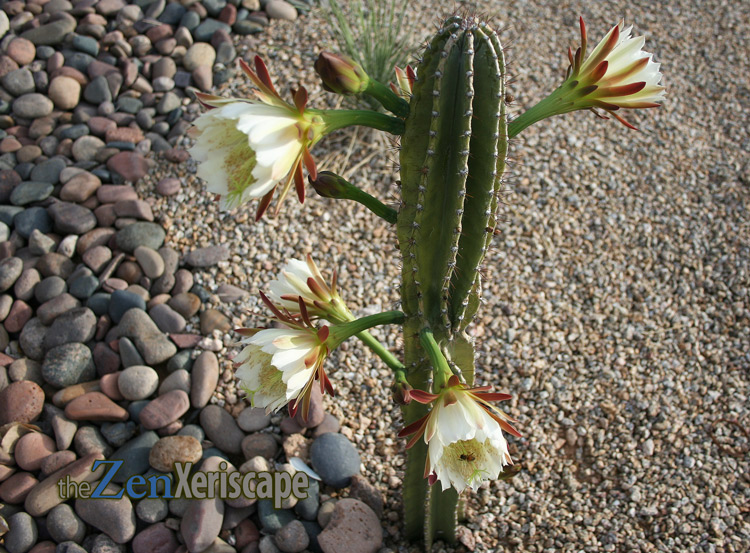
it produced large flowers, which the bees loved.
Roots have become well-established, and
this cactus is ready for the next year of growth.
Photo by Doug Martin
TAKEAWAYS:
How to propagate columnar cactus
Columnar cacti are very easy to propagate. Gather the tools you need, and make your cuttings from a healthy parent plant. I chose a Peruvian apple cactus with two healthy 3-foot stems for my cuttings.
Be sure you knife or saw has been sterilized. Then cut. If your blade is sharp, it won’t take very long.
Allow callous to form on cutting before planting to protect against soil bacteria or diseases. Or, plant immediately like I do. Maybe I’ve been lucky, but I’ve had a high success rate by planting my cuttings immediately, even before a protective callous had formed.
Afterwards, water lightly. Let the soil dry out completely between waterings.
Content and photos by Doug Martin and The Zen Xeriscape